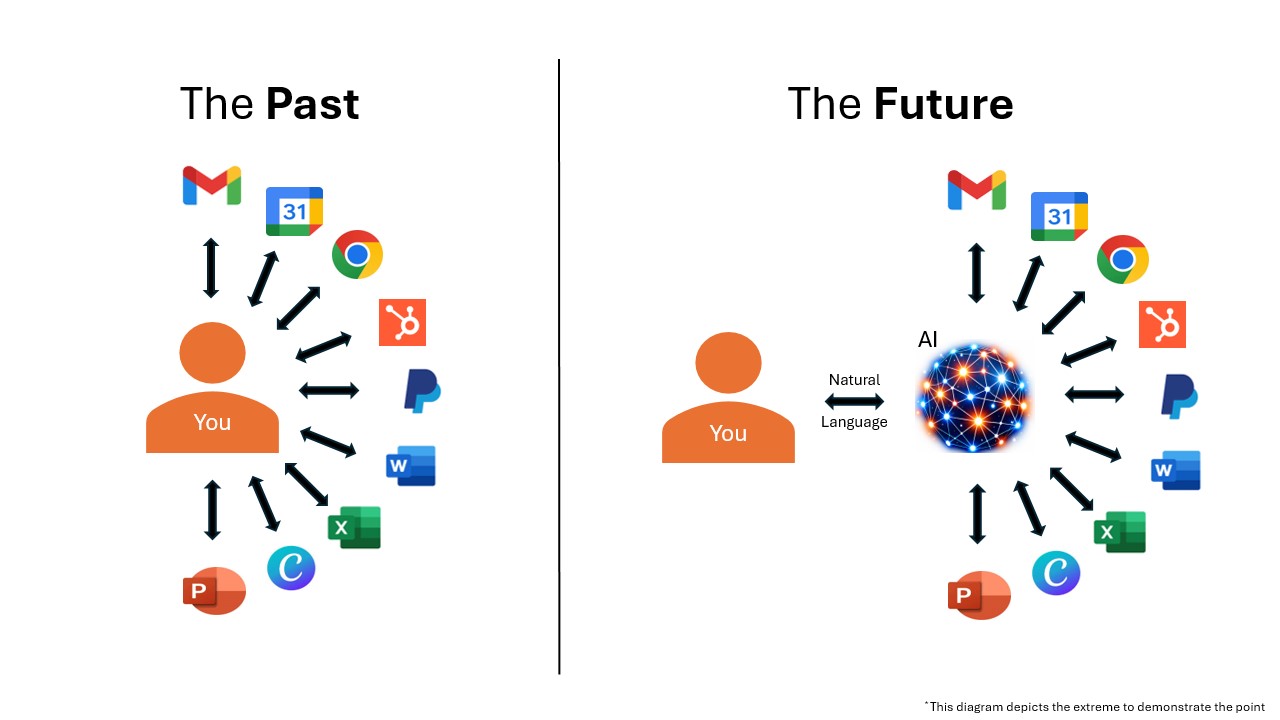
The diagram above shows two ways of running a business. The one on the left is the one you live in.
Every software application you use — your CRM, your accounting system, your scheduling tool, your inventory list, your email — is a self-contained world. It holds information. It supports actions. And it has no idea any of the other applications exist. Connecting them is your job.
You probably stopped noticing this arrangement a long time ago. The job of moving information between systems is so woven into running a small business that it doesn't register as work. It just feels like running the business.
What that arrangement quietly costs you isn't the hours, even though there are plenty. It's the decisions you never make and the actions you never take, because the information that would have informed them is trapped somewhere it cannot be combined with the rest of what your business already knows.
Two kinds of trapped value
Every small business holds two kinds of locked-away value.
The first is information that could combine with other information to answer questions you never get to ask. For example, your job history knows exactly how long projects took and their cost in materials. But your quoting tool doesn't have access to that information. You become the intermediary between your project records and quoting tool. Quotes get built from memory and instinct rather than historic data. Your customer service inbox knows which customers cause the most friction, but your sales pipeline doesn't. So you keep chasing accounts that drain you. Your time-tracking data knows which service offering takes the most labor. Your pricing decisions don't. So your highest-margin work is whatever you happen to assume it is.
In each case, the information your business needs to answer its most important questions already exists. It just lives in the wrong place to be combined with what it needs to be combined with. Instead it requires you to constantly be balancing in the middle of it all.
The second is information that could trigger actions but doesn't. Your accounting system knows about an invoice that is 45 days late. But you have to be the one to manually send the email. Your CRM knows it has been three months since you talked to a high-value customer. But nothing automatically puts them back on your radar. Your project tracker knows a deadline is slipping. But nothing automatically adjusts the rest of your week to compensate.
The signal exists. The mechanism to act on it does not. So nothing happens until you happen to notice, and most of the time, you don't notice until it's a problem.
The shift that's now possible
The reason these silos exist isn't a design flaw. Connecting business applications used to require either custom software development or rigid automation rules that broke the moment anything changed. For most small businesses, neither was practical.
AI assistants like Claude change that. Through a layer called the Model Context Protocol, or MCP for short, AI can now reach directly into your business applications. You describe what you want in plain language. The AI translates that into the specific instructions each system understands, reading information from one tool and taking action in another. The integration work that used to require custom development or manual effort can now happen in conversation.
That is the architectural shift the diagram at the top of this post is trying to show. In the old model, you sit at the center, and every piece of information passes through you before it becomes an action. In the new model, AI sits at the center, and your role shifts from moving information around to deciding what should happen with it.
Here's what most small businesses haven't yet caught up to. This isn't just a productivity upgrade. It's a structural change in what your business is capable of knowing and doing. The mindset shift is small. The opportunity it opens up is not.
Most people are still thinking about AI the way they think about software, as a tool you sit down and use, one task at a time. The next level, the one most businesses haven't reached, is where AI becomes the connective tissue across everything your business already does. It unlocks knowledge by bringing siloed information together. And it can take actions based on that knowledge.
The exercise worth doing this week
The most valuable thing you can do before evaluating any AI tool is to sit with a single question: where in your business does information live in one place but create value somewhere else?
For one workday, pay attention to the moments when you're translating. When you copy a customer name from one system to another. When you cross-reference two tools to answer a single question. When you make a judgment call based on a gut sense that some data, somewhere, would have settled. When you remember a deadline because the system that knows about it isn't the system that would have warned you. When you find yourself wishing you knew something you almost certainly do know, somewhere.
Each of those moments is a clue. They are pointing at information that wants to be combined with other information. They are pointing at signals that should be triggering actions but aren't. They are pointing at the gap between what your business technically knows and what it is actually able to do about it.
That gap is where AI fits. Not as a replacement for your judgment. Your judgment is the part worth keeping. But as the layer that makes sure every decision is informed by what your business already knows, and that every decision can translate into action across every tool you use.
The shift in mindset is the hard part. Once you've made it, you start seeing opportunity in places you never thought to look.
Once you've mapped where your information lives, and where it could combine or trigger action if it weren't trapped, that's where Simply Insilico comes in. We help small businesses put the connectors in place to turn those insights into working AI workflows. The thinking is the hard part. We can help with the rest.