Cerebrum is a tool built for software engineers. If you write code and you write tests for that code, Cerebrum is for you. It runs mutation testing on your codebase using an LLM, and it tells you which of your tests are actually catching bugs and which ones are just there for show.
This is a proof of concept, not a polished product. I built it to solve a problem for myself, and the core engine and web interface both work. But it has mainly been run against my own codebases so far, it is rough in places, and I genuinely do not know yet how well it holds up against other people’s projects. If you try it, go in with that expectation.
Why I built this
I have spent my career in bioinformatics and clinical genomics, building pipelines where a silent bug does not just cost you a bad deploy, it can cost you a wrong answer in a clinical report. Test coverage numbers never told me the whole story. A line of code being executed by a test is not the same thing as that test actually verifying the code is correct. Mutation testing closes that gap, and I wanted a version of it that did not require weeks of manual setup to get value from.
What is mutation testing, and why does it matter
Code coverage answers one question: did my tests run this line of code? Mutation testing answers a much more useful question: if this line of code were wrong, would my tests notice?
Here is how it works. Cerebrum takes your source code and introduces small, deliberate bugs, called mutants. A mutant might flip a comparison operator, change a boundary condition, or swap a variable. Then it runs your existing test suite against each mutant. If a test fails, the mutant is killed, which means your tests are doing their job. If every test still passes even though the code is now broken, the mutant survives, and that is a signal that you have a gap in your test suite.
This is fundamentally a test for your test cases. Coverage tells you where your tests look. Mutation testing tells you whether your tests are actually paying attention when they get there.
This matters more than ever right now because of how much code is being written with AI assistance. When you are vibe coding, iterating quickly with an LLM writing or rewriting chunks of your codebase, it is very easy for a subtle breaking change to slip through a test suite that looks complete but is not actually verifying behavior. A surviving mutant is often exactly the kind of regression that a fast, AI-assisted development loop can introduce without anyone noticing until it hits production. Mutation testing is one of the more reliable ways to catch that.
We are not the only ones who think this matters
Meta has been investing heavily in this space. In early 2025, Meta’s engineering team published work on a system called ACH, Automated Compliance Hardening, which combines mutation-guided test generation with LLMs. Engineers describe the kind of bug they are worried about in plain text, and the system generates both realistic mutants and the tests needed to catch them. More recently, Meta has reported using a related approach they call Just-in-Time testing, generating tests at pull request time based on the specific code diff, and they have reported meaningfully higher bug detection rates in AI-assisted development environments as a result.
That is one of the largest engineering organizations in the world concluding that traditional test coverage is not enough in an AI-assisted development world, and that mutation testing is a key part of the answer. Cerebrum is built on the same core idea, packaged for teams who do not have Meta’s internal tooling budget.
The history, and why LLMs change things
Mutation testing is not a new idea. It has been studied in academic circles since the late 1970s, and the core concept has not changed much since then. What has kept it out of mainstream, everyday use for decades comes down to a few practical problems:
- Cost. Generating and running a large number of mutants against a full test suite is computationally expensive, and it gets worse as codebases grow.
- Unrealistic mutants. Traditional mutation operators are mechanical. They produce a lot of mutants that no real developer would ever write, which wastes time and dilutes the signal.
- The equivalent mutant problem. Some mutants change the code’s text but not its actual behavior, so no test could ever kill them even in principle. Telling these apart from real gaps has historically required manual review.
- Manual effort. Someone still had to write or curate the tests meant to catch the mutants that mattered, which made mutation testing a labor-intensive process reserved for teams with the time and expertise to run it well.
LLMs are well suited to attacking all four of these problems at once. An LLM can reason about what a realistic bug in a given piece of code would actually look like, rather than blindly applying a fixed set of syntactic operators. It can recognize when a mutant is behaviorally equivalent to the original and skip it. And it can generate targeted tests to catch the mutants that do represent real risk, cutting out most of the manual work. This is exactly what has let mutation testing start moving from an academic curiosity into practical, everyday use over the last couple of years, and it is the same shift Meta’s own published work describes.
How Cerebrum works
Cerebrum is built as two components.
cerebrum-engine is the core mutation testing engine. It analyzes your codebase, uses an LLM to generate realistic mutants, runs your existing test suite against each one, and scores the results. This is the part that does the actual mutation testing work and can be run from the command line or wired into CI.
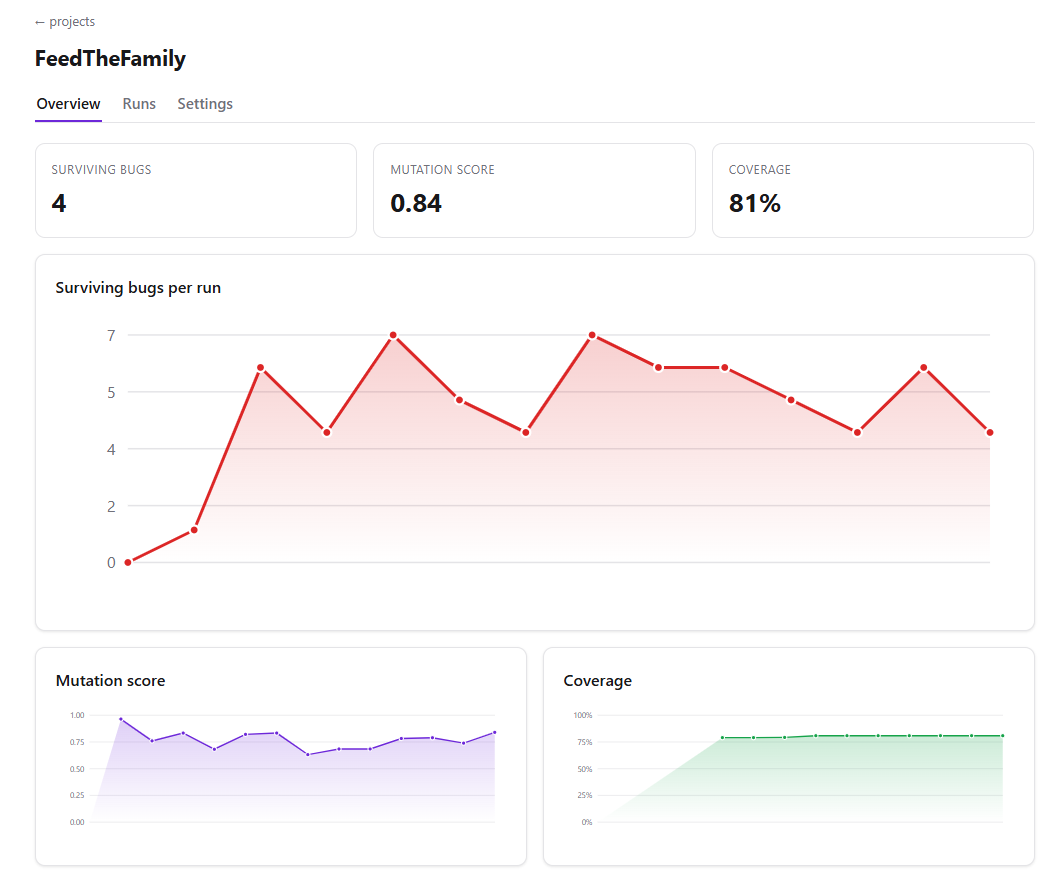
cerebrum-cloud is the hosted web application and dashboard. It gives you a place to view results across runs, track mutation score and coverage trends over time, and see which mutants are surviving so you know exactly where to focus your next test. It is what turns a one-off mutation testing run into something you can track project over project, run over run.
Together, they are meant to slot into a normal engineering workflow: run cerebrum-engine against your codebase, whether locally or in CI, and see the results show up in cerebrum-cloud without extra setup.
Where things stand today
This is a proof of concept. That means:
- The core mutation testing engine and the web dashboard both work, and I use them myself.
- Testing so far has mostly been against my own codebases. I have not yet validated how well this holds up against a wide range of other people’s projects, languages, or test setups.
- The interface, scoring approach, and integrations are all still in flux.
- Expect rough edges. Do not expect polish, and do not expect this to be production-hardened yet.
If you try it out, I would genuinely like to know what worked, what broke, and whether it held up against your own codebase. That is exactly the kind of feedback that turns a proof of concept into something more.
Get started
Ready to see how your test suite holds up? Give Cerebrum a try.